• Skip to primary navigation
  • Skip to main content
  • Skip to primary sidebar

My Obstacle Course: Engage, Encourage and Empower

A fun, structured, systematic way to work on your child's strengths and weaknesses at home!

  • Welcome to My Obstacle Course!
  • What is My Obstacle Course?
  • Developmental Timelines
    • What Is My Child Ready For?
  • About Us
  • Blog
  • Contact Information

My Obstacle Course Station Ideas

Building Letter Recognition – Sensory Bin Letter Hunt

I recently received a letter asking about activities to work on beginning letter identification and uppercase/lowercase matching. As with any concept I work on with Andrew, I begin by providing him with very basic activities and build according to what he needs. This is one of my favorite ways to approach this and lots of other skills.

Note: Remember that these station activities are not meant to be long, drawn out projects that take all afternoon for your child to complete. They have short attention spans which is why doing stations that are quick and to the point work so well.

My Obstacle Course Station Activity: Sensory Bin Letter Hunt

My Obstacle Course Station Activity: Sensory Bin Letter Hunt

For this station activity I would choose some letters, either strategically if I knew he was struggling with them or randomly.

The letters I chose for this particular hunt.

I have used magnet letters, Scrabble or Bananagram letters, wooden letters from a Melissa and Doug game or letter tiles I found at Michael’s.

Magnet letters, wooden Melissa and Doug letters, colored letter tiles from Michael's and Bananagram (or Scrabble) letters

I combined these with a sensory bean bin that I have made. (Now that summer is approaching, it might be fun to go with the summer theme and make a sensory bin with sand! Just remember to put a towel or sheet underneath it for easy clean-up.)
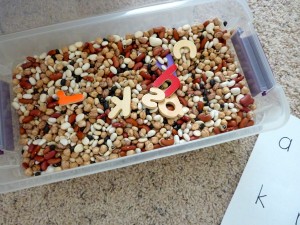
Place the letters in the sensory bin and bury them.

I include a sheet with the letters on it so they can be matched up and so that he knows how many more he needs to find. This does not have to be fancy, just a sheet of paper with the letters neatly written on it or even printed from the computer using a large font size.

Now that the set up is complete (super simple huh!!), it’s time to start digging!

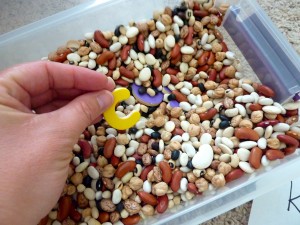
Dig around until a letter appears.
Take the letter out...
and place it on the sheet.
Continue until they have all been found!
What it would look like matching uppercase and lowercase letters.

If your child knows their letters, an extension of this would be to place letters into the bin that form a word. Write the word on a piece of paper or a piece of a sentence strip and the child can put the letters in the correct order to form the word.

It really doesn’t take much to make a fun activity to help your child build letter recognition skills.

Engage, Encourage and Empower!
 

Make the Same – Part 2

I modeled this My Obstacle Course station activity after several packaged toys I’ve seen that come with pattern cards for children to replicate. It’s so easy to make your own and custom fit them to what your child needs to work on.

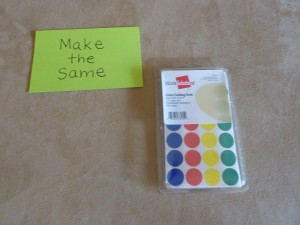
To make them, I used some color coding dot stickers that I found in the school supply/household utility aisle of our grocery store…

Make the Same station activity using color coding dots.

and some index cards (I used colored but plain white cards might work even better).

I used the sticker dots to make basic patterns – ABAB, AAB, ABB, ABC, etc.

My Obstacle Course pattern cards - ABAB pattern (the yellow dots can be seen in person but didn't photograph well)
My Obstacle Course pattern cards - ABB pattern
My Obstacle Course pattern cards - ABC pattern

At the station, I provide paper and stickers, have him choose a pattern card and using the stickers, he peels and sticks the dots on to make the same pattern. If this activity is easy for him, I would have him choose several different cards to do. If it is too challenging, I would limit it to two.

I like that this works on the skill of patterning as well as building the fine motor skill of using their fingers to peel, hold and place the sticker onto another sheet of paper. This also requires some planning because they have to put the sticker in a place that will allow the others will fit. If planning is challenging, you can place lines or x’s on the paper for them to place the sticker on or above.

These sticker dots have other uses as well that I will post on in the near future. I really like finding inexpensive items that have multiple purposes for building different skills!

Engage, Encourage and Empower!


Make the Same – Part 1

One of my favorite My Obstacle Course station activities is something I call, “Make the Same.” This is a station activity that I came up with to help Andrew build imitation skills. After using it a few times, I realized that this activity not only helps with imitation, but also fine motor skills, visual and spatial planning, and is helpful if your child has toys that they do not play with (maybe it’s because they don’t know how!).  By breaking down the toy into smaller, more manageable tasks that they can copy, you can help build these play skills.

I love the versatility of this activity. It is an activity that can incorporate almost anything, like blocks, pattern pieces, objects, stickers, shape drawing, and eventually letter and word writing.

It is so easy to set up and works on skills that provide the foundation for more complex skills needed in the future.  The basic idea is to make something, provide your child with the same parts or pieces that they will need to make what you’ve made and then work with them to make it.  When beginning, provide the exact blocks or pieces they’ll need and as they progress you can make it more challenging by providing more blocks or pieces so they have to choose only the ones they’ll need.

Here are some ways I have used it in past My Obstacle Courses:

My Obstacle Course station activity: "Make the Same" using blocks.
My Obstacle Course station activity: "Make the Same" using pattern beads and pipe cleaner.
"Make the Same" activity completed.

These next two station activities could also be combined with a clothesline and clothespins to incorporate fine motor skill building.

My Obstacle Course station activity: "Make the Same" using ocean themed pattern cards.
"Make the Same" activity completed.
My Obstacle Course station activity: "Make the Same" using soccer themed pattern cards.
"Make the Same" activity completed.

A toy that had not been played with is broken down into manageable parts.

My Obstacle Course station activity: "Make the Same" using Magformers

The great thing about “Make the Same” is that you can make it as basic as you need or as complicated as your child needs (right now I’m thinking Lego creations since we haven’t gotten into Lego-mania yet!).

Tomorrow’s post will be another version of “Make the Same” using some basic, easy to find materials to help your child with more intricate fine motor skills and planning.

Engage, Encourage and Empower!


Party Tray Sorters

I found these bright, colorful, plastic party trays last year (I think at Michael’s but I cannot remember for sure 🙁 ). You can pair one of these trays with items like colored puffs, thematic felt stickers, goldfish crackers, buttons, beads, or anything that can be sorted by a specific characteristic (color, size, etc.) and you have an easy My Obstacle Course station activity.

Here are some ways I’d use them:

My Obstacle Course station activity: Sort puffs by color.
My Obstacle Course station activity: Sort puffs by size.
My Obstacle Course station activity: Sort by sport. (These are felt stickers I found at Michael's.)
My Obstacle Course station activity: Sort Goldfish crackers by flavor.
My Obstacle Course station activity: Sort the magnets by color.

Obviously, you do not need these particular party trays. I am just showing how to use something that was colorful and inexpensive to create a fun, easy activity to build sorting skills.

Engage, Encourage and Empower!


Learning Styles

With each of the My Obstacle Course station activities I share, I try to make sure that each one incorporates all of the learning styles:

visual

auditory

kinesthetic

This was drilled into me while studying education during college and it has stuck with me – thank goodness! I feel that it is so important to present concepts and skills this way because I know that no matter what a child’s learning style is, they are getting it presented in the way they learn best. This does not mean that you have to create complicated, intricate, detailed station activities. It really is as simple as using written out directions or picture cues, talking through something with your child while doing it or providing them with items they can manipulate while sorting or matching. See pictures to see how simple this really is but know that it makes a huge difference!

Super simple station activity that uses visual, auditory and kinesthetic learning modalities.

By incorporating all of the learning styles, I learned that Andrew is a visual learner and since he was not able to verbalize all that he knew, he was able to demonstrate his knowledge kinesthetically through sorting and matching. Auditory processing is not a strength for him. I can say things over and over again until I’m blue in the face and while I know he hears me and remembers the craziest of things (at least in my mind!), I know that if I want him to process and understand something, he needs to read it or see it. This is especially helpful when it comes to directions, social rules or behavior reminders.

Personal Note:  It is not uncommon to find me out with him at restaurants or social gatherings holding a sheet of paper with behavioral expectations (specifically what it looks like/doesn’t look like depending on what we have had difficulties with) and the consequences of following those rules printed out. It is all right there for him to see and he has the choice to follow or not follow knowing that his choices determine what he gets to do or not do. He looks it over when we leave the house, when we get to where we are going as well as any times he may need gentle reminders.

Engage, Encourage and Empower!


Cool Tool – Reading Guide

On one of my recent visits to the teacher store, I was in the literacy aisle and noticed that they had these colored reading guides.

Reading Guides by Ashley Inc.

These are a great tool to help children focus on what they are reading, really making the words stand out and reducing the amount of background distraction.

This small reading guide highlights single lines of text.
The reading guide blocks lines of text above and below.
This big reading guide highlights paragraphs.

They come in lots of different colors which may make it a bit more fun and motivating for a struggling readers.

I do realize this is not a totally new concept, someone just took an old idea and made it better! This tool just goes one step further than rulers, bookmarks or construction paper strips, by blocking out the lines above and below the line they are reading. I would always use bookmarks under lines of text that I was reading, especially when the material that was new or challenging. As a teacher, I would have my students use rulers, bookmarks or strip of colored construction paper, underneath the lines that they were reading to keep their place and help them focus. Wish I had these back then!!

If your child struggles with reading, this tool could help! If you don’t have a teacher supply store nearby and are interested in this, here is a link to the reading guides on Amazon.

Engage, Encourage and Empower!

« Previous Page
Next Page »

Primary Sidebar

Obstacle Course Mom’s Blog

  • When People Stare, Mind Your Own Business
  • ABC’s of Peaceful Parenting Tele-class
  • What’s Perfect About This?
  • Exciting News!
  • Halloween

Categories

  • Blog
  • Cool Tool
  • Fine Motor
  • Getting Started
  • Gross Motor
  • Literacy
  • Math
  • My Obstacle Course Station Ideas
  • Oral Motor
  • Problem Solving
  • Sensory
  • Social Skills
  • Uncategorized

Archives

  • July 2012 (1)
  • May 2012 (1)
  • January 2012 (1)
  • November 2011 (2)
  • October 2011 (12)
  • September 2011 (14)
  • August 2011 (15)
  • July 2011 (19)
  • June 2011 (18)
  • May 2011 (21)
  • April 2011 (20)
  • March 2011 (22)
  • February 2011 (19)
  • January 2011 (21)
  • December 2010 (22)
  • November 2010 (6)

Meta

  • Log in
  • Entries feed
  • Comments feed
  • WordPress.org