• Skip to primary navigation
  • Skip to main content
  • Skip to primary sidebar

My Obstacle Course: Engage, Encourage and Empower

A fun, structured, systematic way to work on your child's strengths and weaknesses at home!

  • Welcome to My Obstacle Course!
  • What is My Obstacle Course?
  • Developmental Timelines
    • What Is My Child Ready For?
  • About Us
  • Blog
  • Contact Information

Search Results for: scrabble

My Obstacle Course Kit Item #2: Scrabble or Bananagram Letters

Kit Item #2: Scrabble or Bananagram Letters

This will probably come as no surprise to any of you who read my posts, but item #2 that would definitely go in My Obstacle Course kit would be either Scrabble or Bananagram letters. I love them because they are so versatile. They can be used on their own or paired with a wide variety of things (sensory bin, flash cards, word clues) to help make building basic literacy skills fun.

Their small size also makes them perfect for building fine motor skills. Like dice, they are easily stored in a plastic bag or container and require nothing more than you choosing how to use them as a station activity.

Bananagram letters (which look just like Scrabble letters without the little numbers)

Note – If these letters are too small for your child and you worry about them putting them in their mouth, use something bigger like magnet letters. These can be found in most grocery stores, pharmacies as well as department stores like Target.

Uses:

  • letter identification (ex. Find the letter __.)
  • letter sequencing (ex. Put the letters in abc order.)
  • choosing the letter that goes with a spoken sound (ex. Choose the letter that makes a /b/ sound.)
  • building words
  • word families
  • make the same using flash cards
  • sight word building

Click here for a link to the “Scrabble” search of my past posts to see some of the ways that I have used them with Andrew.

Sample Station Idea:

My Obstacle Course Station Activity: Letter Sequencing
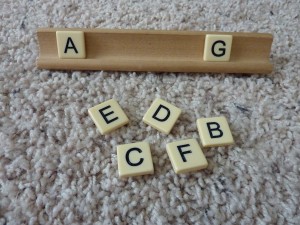
Station set up for putting letters in the correct sequence.
Putting letters in order.
Letters A-G in the correct sequence.

Another Activity Idea:

My Obstacle Course Station Activity: Fill in the missing letters

Another variation - putting out every other letter for the child to fill in the missing ones.

If this is a skill that your child struggles with, provide them with a reference sheet. Remember that these activities are for reinforcement or building skills, so if they need something to refer to or check their work, provide that for them. This is as easy as writing this out on a sheet of paper or printing it off.

Engage, Encourage and Empower!


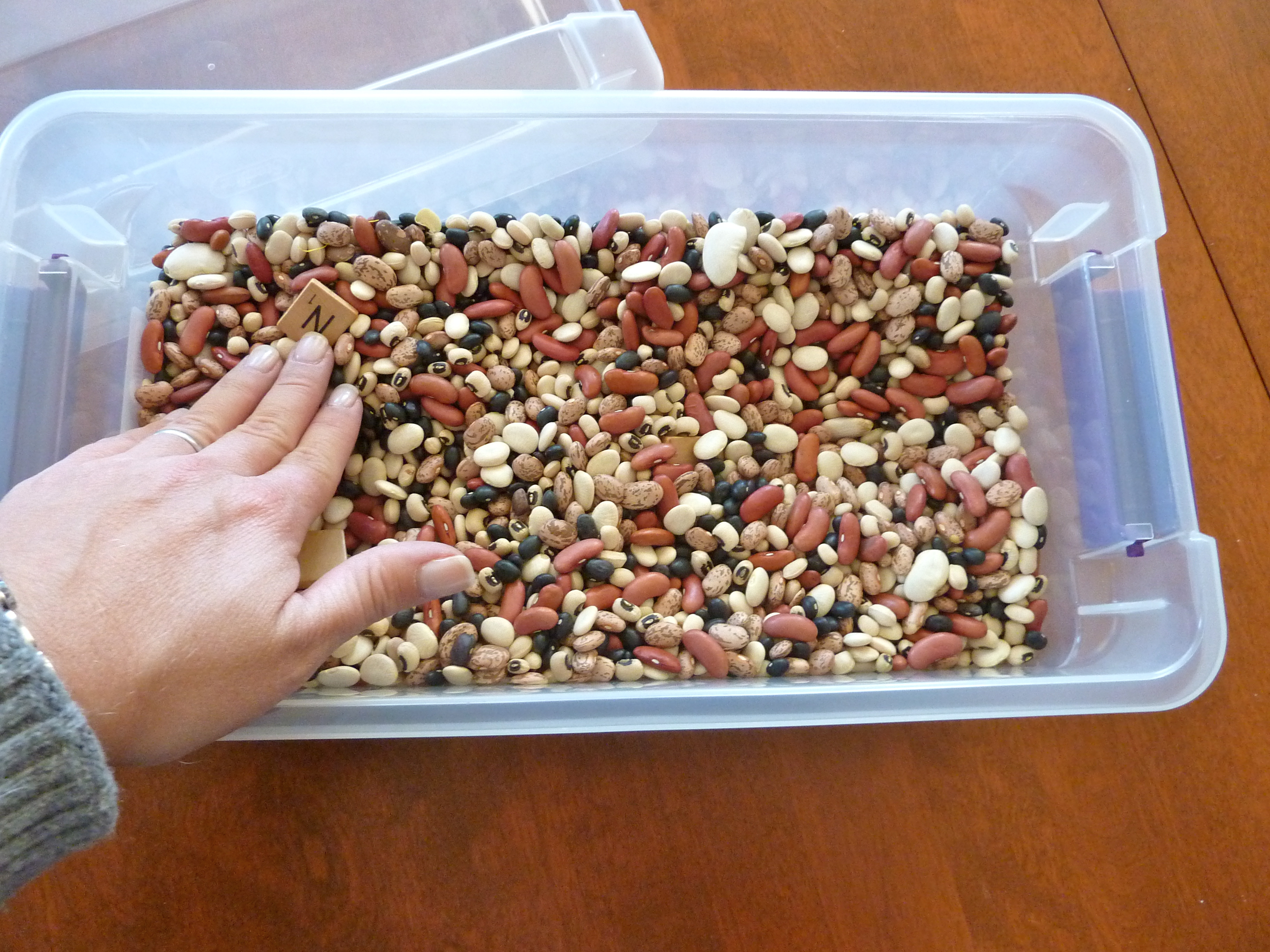
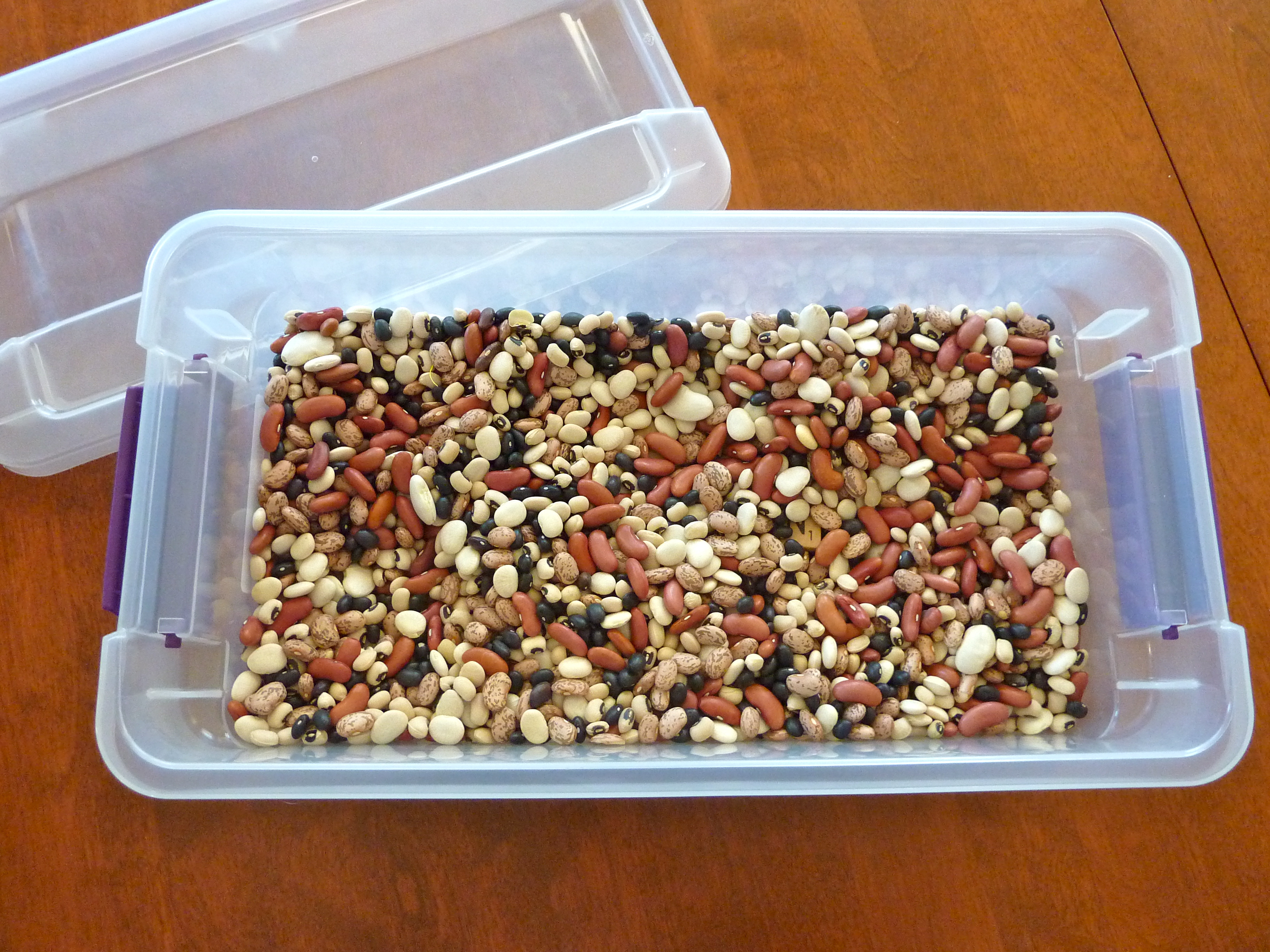
Sensory Bean Bin Add-In: Scrabble Letters

I love using the bean bin in My Obstacle Courses because I can work on my son’s sensory issues while combining it with things that he finds interesting.  He loves letters and words so for us it makes complete sense to combine the two!

Most everyone has a Scrabble game in their house, a game that is new to me, Bananagram (which has Scrabble-like letters), or those colorful magnet letters for the refrigerator.  I realized that using items like these would be a fun, literacy based add-in to the sensory bin and could be used in many different ways.  Here are a few:

Letter Identification

1.  If your child is working on letter identification, place some letters in there and when they are found, identify them together.  One extension of this could be sorting the letters by vowel and consonant.

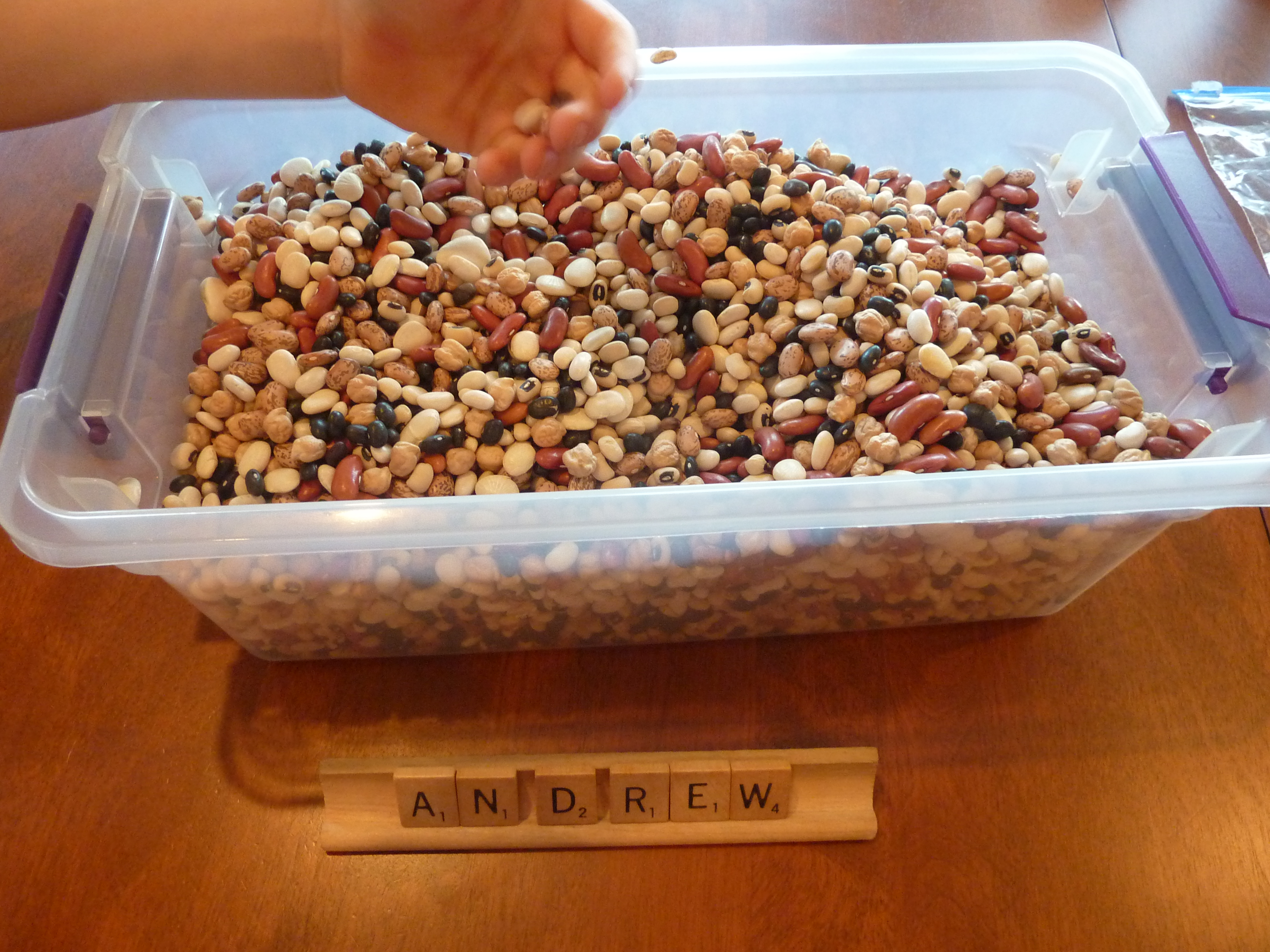
Adding Scrabble letters to the bin. They can be chosen randomly or if you know of certain letters that are stumping your child, use those!
Put the letters into the bin.
Push the letters down into the beans so they are well hidden.
Letters are hidden. Time for your child to dig in!!

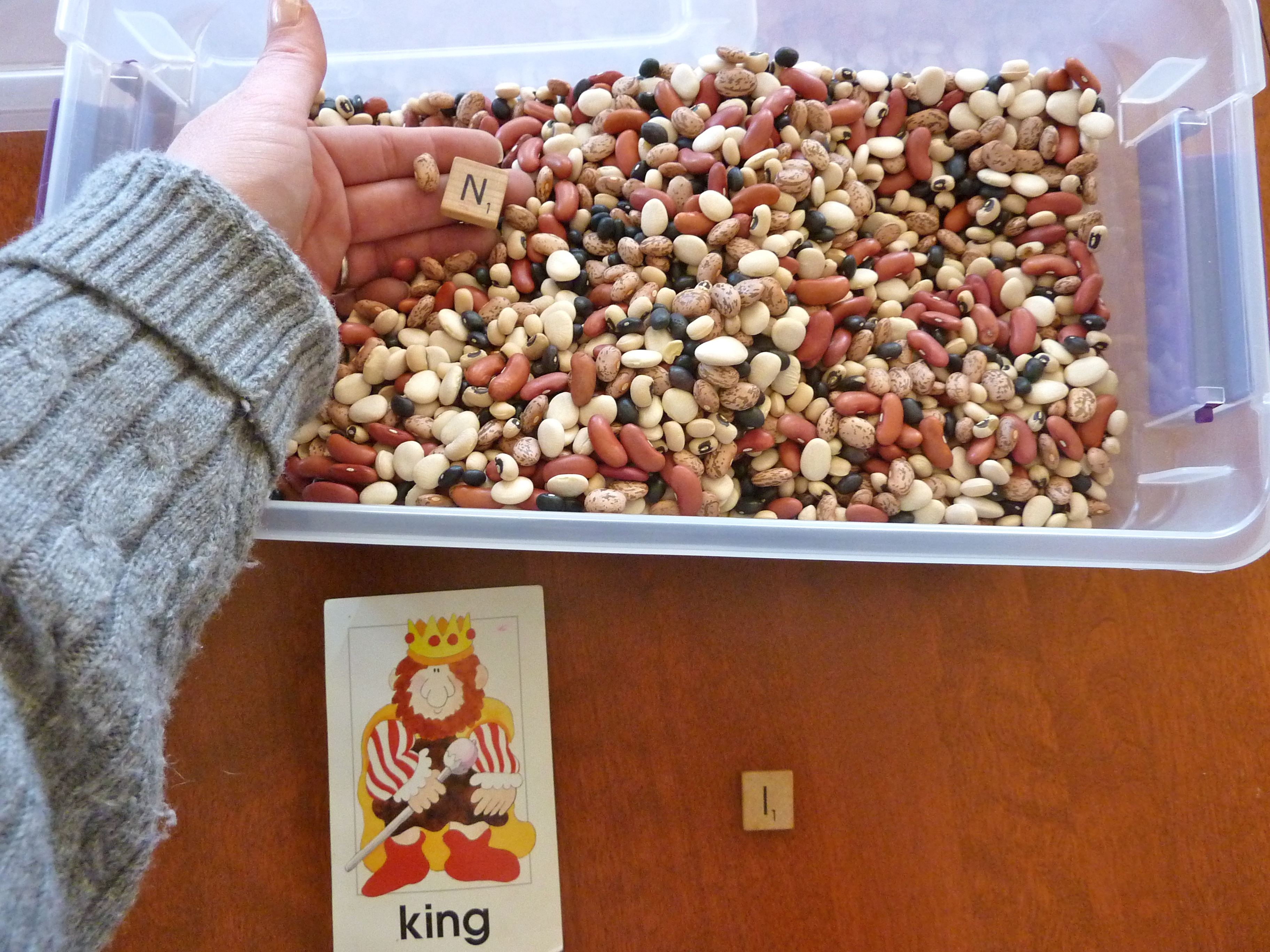
Making Words- Child’s Name or Picture Card Word

2.  Put only the letters in the bin that are needed to make a certain word (ex. their name or a word on a picture flash card).  Have your child find the letters and “make the same” word as on the card.

Use letters from their name!
Put the letters in and mix them to hide.
Your child digs in to find letters of their name.
Andrew found all of the letters to make his name!

Or…

Choose a card and put the letters to make that word into the bin.
Hide the letters in the beans.
Have your child dig in the beans to find the letters.
All of the letters found and put in order to make the word!

Mystery Word

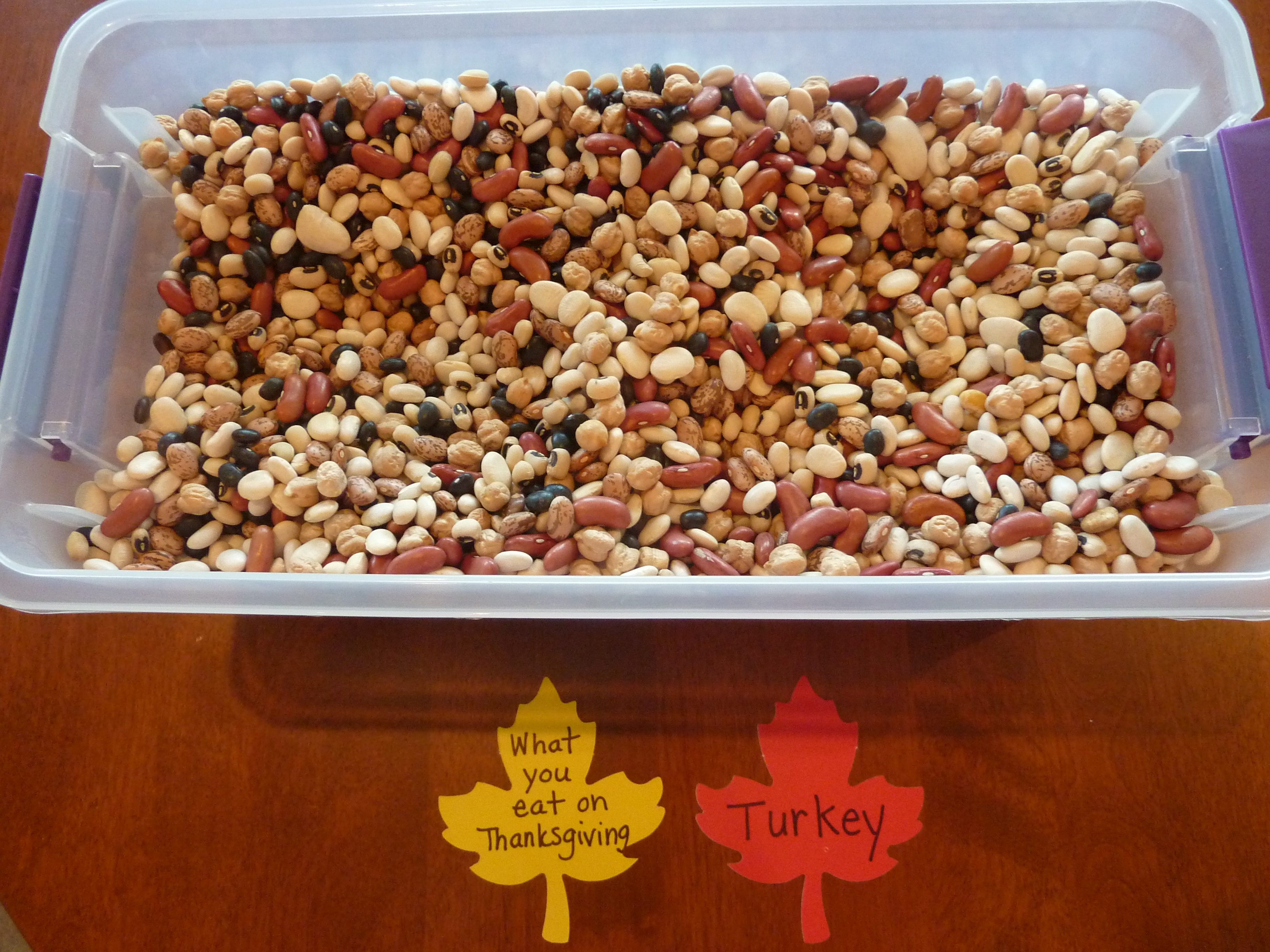
3.  Put only the letters in the bin that are needed to make a certain word based on your theme or something they are studying in school.  Write out a clue for your child to see if they can identify the word and spell it using the letters found.  You could provide a Hangman-type sheet of paper with the exact number of letters so they have a place to work with and play around with the letters until the word is figured out.  Additional clues can be given if it turns out to be too challenging- remember, this is supposed to be fun time with you!!

Write out a clue for the word you want to them to spell and then gather all of the letters needed to spell it. Â Now hide the letters before your child sees the answer!!
Letters to make up the mystery word are in the bin ready to be mixed into the beans and hidden.
Letters are hidden, ready to be discovered. Read the clue and your child can dig in!
Use an answer card if your child needs assistance spelling the mystery word.

Back To School Tip #7

Decoding the Teacher’s Weekly Letter

I’m sure that most of you get a letter at the beginning of the week from your child’s teacher explaining the themes, concepts and skills they are working on in class. This is an important way for them to communicate with you what they are teaching your child in school. This letter is also a great way for you to get ideas for how to reinforce what they are doing in school at home. How can you do this? Through simple station activities as part of My Obstacle Course!

My mission is to help parents “engage, encourage and empower” their children and what better way to do that than by reinforcing what they are working on in school in a fun way in order to strengthen the connections and knowledge. When I began doing this with Andrew, he would always look at me with one eyebrow up, like “How do you know about this stuff?” It helped me to see firsthand what vocabulary he understood, gave me specific examples of how he applied his knowledge and understanding and also gave him some extra time to build skills in a safe, loving environment – our home!

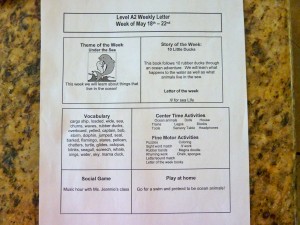
Here are some sample letters I have saved from Andrew’s classes over the years and some ways I would use them:

Sample 1
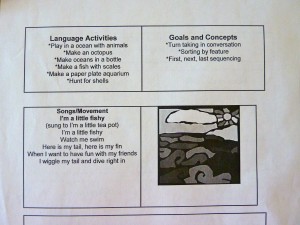
Sample 1, other side of paper

Sample 1 is clearly an “Ocean” themed week, so I would treasure hunt for ocean related items to include. I would look for books, bath toys, kitchen items that could be used to encourage water play. I would also try to find pictures to go with the vocabulary words they were working on to help reinforce the word and the meaning.

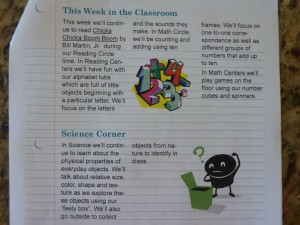
Sample 2

For Sample 2, I would include alphabet related activities to reinforce “Chicka-Chicka Boom Boom.” We have the book so I would use that as part of a read aloud or fluency station. For math, I would work do a matching station with a certain number of letters (to reinforce literacy) matched up with that number for one-one correspondence. I’d also play a game where we try to see how many different ways we can make a certain number (ex. for the number 10 – 1+9, 2+8, 3+7, 2×5 (two groups of five – never too early to begin working on multiplication 🙂 ), 11-1, etc.).

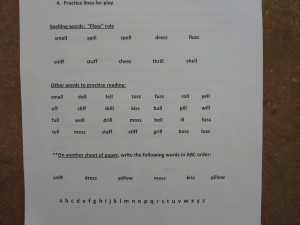
Sample 3

Sample 3 is obviously working on building literacy skills so I would be utilizing word cards and letters to build these words (see ideas below). A chalkboard, white board or MagnaDoodle would be great for a station where they are writing their spelling words.

Sample 4

Sample 4 screams out “Crawl and Match” for me. I would either write the compound word parts on separate cards or print them out a little larger and then cut them apart. I would place the beginning part of the word on one end of the carpet runner and the other half of the word on the other end of the runner so he could get the word part, crawl down and match it with the correct ending. I would not do all of these as one activity – way too many, but may do two separate stations – the “Crawl and Match” and then maybe “Clothesline Clipping” the word parts together.

General Activity Suggestions:

Letter Recognition

  • Matching
  • Sorting
  • Clothesline clipping uppercase and lowercase letters together
  • Sensory bin with letters (scrabble, magnet, tiles, beads)

Building Receptive and Expressive Vocabulary

  • www.EnchantedLearning.com is a great resource for thematic vocabulary with pictures to go with the words
  • Matching words and pictures
  • Sorting pictures by category

Spelling or Word Study Words

  • Using Scrabble or Bananagram letters to create the words
  • Word matching game (like memory match but with the same word written on two separate cards to match together)
  • Word sorting according to patterns (pairs well with “Crawl and Sort” to encourage physical movement while building literacy skills)
  • Putting words in ABC order (starting with a few if this is a new concept while also providing the written alphabet for reference)

Read Aloud Station

  • Read by you to build listening stamina and skills like sitting in one place, staying quiet, listening for information, retelling, etc.
  • Easily combined with comprehension questions – who? what? when? where? why? how? – which can be written on a beach ball to pass back and forth or written on cards for the child to flip. Either way helps to build question and answer skills.
  • The public library is a great resource for themed books. Call and ask the librarians to pull books based on a certain theme for a certain reading level. I would give them a few days to pull them and if you don’t want to make lots of trips, I’d ask your child’s teacher what the themes/concepts will be for the next few weeks to save you time.

Fluency Practice

  • Fluency is building reading skills through short passages so that it comes out smooth, clear, with expression and taking note of punctuation. If you start with material that is too difficult, it will be choppy as they work to decode the words. Start with passages that they can read easily, even if it is the ABC’s, so that they build their confidence.
  • This is fun with a toy microphone (I’m thinking of the plastic ones that echo and are sold at the Dollar Store.), paper towel tube as microphone (I’ve even seen people put tin foil over the top to mimic a real one.), or even recording them so they can listen to themselves

Math Fact Practice

  • Dice
  • Playing cards
  • Dominos (adding or subtracting the two sides together)
  • Combining flash cards with manipulatives to make sure they are getting a good understanding of the concept

Unit Studies in SS or Science

  • Treasure hunt at home to see if there is anything you can find to help reinforce this (books, toys, pretend play items, etc.)
These suggestions are based on general skills or concepts that tend to be sent home for practice. There are obviously many more, and if you have some that you’d like me to post on ways to make it more fun and engaging, let me know! I love this stuff!! obstaclecoursemom@yahoo.com

Engage, Encourage and Empower!

Sports Themed My Obstacle Course Idea #3

Enchanted Learning Website – Sports Theme

I have mentioned this website before (click here for previous Enchanted Learning post) because I love how easy they make it to be thematic while building academic skills. It is a subscription site with some free materials but I have found it to be worth the fee for what I do with Andrew and My Obstacle Course.

My intention is to provide you with some alternatives for what would typically be worksheet, pencil/paper activities. If your child is into that, than by all means go for it! I have just found that with Andrew, the more engaged he is, the more willing he is to put time and energy into building skills in all areas.
I will often cut the pages apart to create crawl and matching stations or combine them with Scrabble letters to get him more involved with actually making words.

Based on the activity sheets that they have on the page I’ve linked to above (there are lots!), these are some ways I would incorporate them into a sports themed My Obstacle Course:

  • Matching pictures with words from the “Sports Word Wheel” or the “Match Sports Words with Pictures” pages (I would cut them apart and combine with clothespins)
  • Combining syllables to make sports words (combine with crawl and match station)
  • Filling in missing letters to form sports words (I’d use the pictures and combine them with Scrabble letters)
  • Unscrambling letters to form sports words (I’d use the pictures and combine them with Scrabble letters)
  • Using the sports question page, I would cut apart the words, set them out and use it as a questioning station where I ask him the question and have him choose the correct word.
  • ABC order page, I would cut apart the words and have him actually put them in ABC order. If this was a challenge, I would include a written out alphabet to use as a reference.
  • Compound words – I’d either cut them apart or use this sheet as a sample and write out the word parts on small index cards or Post-It notes so he can combine them to form the words.
  • There are also a ton of anagram activity pages, which use the letters from one word to create another word. I would use Scrabble letters with something like this and would only do a few anagrams at a time as a station, starting with some smaller, easier words to introduce this to him.
  • I would use the “Sports Alphabet Code” page as is.
  • I would cut out the words at the top of the Venn Diagram page but would keep the bottom section as is and have him sort the words into the correct section.
Note: I do not have any affiliation with Enchanted Learning. I discovered their site while teaching 3rd grade, loved using it with my students for research purposes and found it to be extremely helpful when working with Andrew at home.
Engage, Encourage and Empower!!

Sample My Obstacle Course Using Kit Items

I hope you have found these past posts on what I would include in a basic My Obstacle Course kit helpful. These are just some of my favorites and are examples of items that could easily be assembled to provide activities to help build your child’s skills. I encourage you to go on a little treasure hunt through your own house and see if there’s anything else you can find. (Click here for a past post on Treasure Hunting At Home.)

Academic and Developmental Skill Areas

Just like when I set up My Obstacle Courses for Andrew, I include things to build a variety of academic and developmental skills. The areas I focus on are:

  • Literacy
  • Math
  • Fine Motor
  • Gross Motor
  • Oral Motor
  • Sensory
  • Problem Solving
  • Social Skills

Sample My Obstacle Course

With the kit items I have given you, below is a sample My Obstacle Course. Please remember that the MOST important thing to remember is to provide activities that YOUR child is ready for at the level they are ready for, regardless of their age. These activities can be modified up or down in difficulty so keep that in mind.
  1. Pass the question beach ball back and forth 5 times, asking and answering questions based on the question word in front of you when caught. (Social Skills and Gross Motor)
  2. Crawl through the fabric tunnel. (Gross Motor and Sensory)
  3. Unscramble the scrabble letters to make words that go along with clues. (Literacy and Problem Solving)
  4. Write the words you’ve made with the scrabble letters on the lined write on/wipe off board. (Literacy and Fine Motor)
  5. Crawl through the collapsible tunnel or under three chairs lined up (3 is just an example number!). (Gross Motor)
  6. Roll one die and use the tweezers to move that many puffs. Repeat with the other die and then count how many puffs in all. (Click here for a post on Easy Math Organizers with a description of this activity minus the tweezers and click here for a post on Tweezers with puffs.) (Math and Fine Motor)
  7. See how many different shades of blue you can make using the droppers and colored water. (Different Shades of Blue) (Fine Motor and Problem Solving)
  8. Clothesline clipping- matching up addition equations with their sums. Look at the equation clipped on the clothesline and find the sum. Clip them together and move onto the next equation. (This could be done easily using equations and sums written on index cards or pre-made flash cards with sums written on cards.) (Math and Fine Motor)
  9. Puff Blowing- Blowing puffs (with mouth or straw) off of a counter into a cup or bowl. (Puff Blowing) (Oral Motor)
This is just an example to show how easy it is to set up a basic My Obstacle Course using these kit items.
My next post will be on my favorite go-to station activities that are easy to make and adapt to different skills and levels.
Engage, Encourage and Empower!
Make The Same- Sight Word Building

Have I ever mentioned that I love using things I already have around my home to help Andrew build developmental and academic skills? Perhaps only a hundred times but it is so true! I also like to pass on ideas to you that are simple to put together and also easy to adapt to various skill levels.

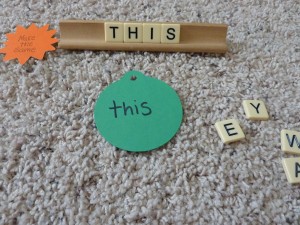
Most everyone has Scrabble or Bananagram letters in their house and they are so great to help build literacy skills. In this My Obstacle Course Station Activity, I have combined some basic cards with sight words written on them with these letters to create a different version of my “Make the Same” game. (Click here for a list of Dolch Sight Words.)

Sight word cards on a ring.
Bananagram letters

My Obstacle Course Station Activity: Make the Same – Sight Word Building

I had picked up this colorful pack of round cards that are perfect for creating flash cards (You could also use index cards or any note paper that you have at home, I would just recommend that it is thick enough so you are not be able to see the word from the other side.). This particular set comes with one of those binder rings to keep them organized and make it easy to flip through them.

For this activity though, I went through and chose some words to build and took them out of the pack. I flipped them over to make it more of a game, giving him the choice of which card to flip over first and set out the letters he would need to make the words. The set up for this only took a few minutes and could be done with basic word families (click here for a list of common word families on EnchantedLearning.com), spelling or Word Study words, thematic or unit study vocabulary words or words that go with a speech sound your child is working on.

My Obstacle Course Station Activity: Make the Same

This is such a simple game but gets the child actively involved in putting the letters together to form the word. This can help children who are having difficulties with sight words and utilizes all modalities of learning – visual (seeing the word), auditory (hearing the word said out loud) and kinesthetic (putting the letters together to form the word).

Flip the card and spell the word.
Spelling the word "they".
Spelling the word "this".

The fact that this is turned into a game and that they have the choice of which card to flip helps to reduce the struggle and frustration that can occur when practicing or building skills that may be more challenging.

If your child is ready for more of a challenge, have them choose the card, read the word to them without letting them see it and see if they can put it together. If they get stuck, the card is there to help them correct any errors.

Engage, Encourage and Empower!

Next Page »

Primary Sidebar

Obstacle Course Mom’s Blog

  • When People Stare, Mind Your Own Business
  • ABC’s of Peaceful Parenting Tele-class
  • What’s Perfect About This?
  • Exciting News!
  • Halloween

Categories

  • Blog
  • Cool Tool
  • Fine Motor
  • Getting Started
  • Gross Motor
  • Literacy
  • Math
  • My Obstacle Course Station Ideas
  • Oral Motor
  • Problem Solving
  • Sensory
  • Social Skills
  • Uncategorized

Archives

  • July 2012 (1)
  • May 2012 (1)
  • January 2012 (1)
  • November 2011 (2)
  • October 2011 (12)
  • September 2011 (14)
  • August 2011 (15)
  • July 2011 (19)
  • June 2011 (18)
  • May 2011 (21)
  • April 2011 (20)
  • March 2011 (22)
  • February 2011 (19)
  • January 2011 (21)
  • December 2010 (22)
  • November 2010 (6)

Meta

  • Log in
  • Entries feed
  • Comments feed
  • WordPress.org